 AlxcBTWandClaude Opus 5.5
18d9874a06
A packed ancillary word that still reaches an export, or any other read
the masked-select pass cannot drop, no longer stops the recompile. After
that pass every remaining use gets the composed word: the primitive class
at bits 0-1, SampleId at bits 8-11 and Layer at bits 16-28, with every
other bit zero. Those lanes do export the ancillary VGPR on the console,
so the word has to be right, not just present.

The primitive class (0 point, 1 line, 2 triangle, 3 rectangle) comes from
the draw. RasterPrimitiveOf maps rect lists to 3, line lists on the vertex
path to 1 and everything else the driver accepts to 2, because its
geometry and tessellation paths only output triangles. It reaches the
shader as pipeline specialization constant 8233, the way dual-source
blending does: a request field that is folded into the specialized
module and is part of the result memo, the draw key and the serialized
request (version 17).

Only shaders that read the class pay for it. ShaderInfo records the read
(disk cache format 28), and only those shaders put the class in their
module key, so a shader that reads just the sample or layer field keeps
one module for every primitive class. The draw sets the class only when
the pixel shader loads the ancillary VGPR, so other draws keep the draw
cache entries they have today.

The VRS rates (bits 2-5) and the eye id (bit 7) are 0 because the driver
supports neither VRS nor multiview. SampleId is 0 because the driver
rejects MSAA and per-sample shading, and Layer is 0 while it ignores
vertex layer exports. TechnicalDebt.md records the layout sources and
these assumptions.

Tests:
- pixel_ancillary builds an export to target 0 whose two channels select
  between a packed value and a phi carrying the word. It checks the word
  for each primitive class, sample and layer, checks that the three
  shapes the masked-select pass keeps now compile with the composed word,
  and that a program whose select the pass drops reads no class.
- agc_driver_pixel_ancillary_word exports the word from a draw and reads
  back 2, 3 and 1 for triangle, rectangle and line. A shader that reads
  only the sample field shares one module across the classes, and the
  whole-word shader gets one per class. It also checks RasterPrimitiveOf.
- agc_shader_memory covers the version 17 round trip, and
  agc_shader_disk_cache the new flag.

Both ancillary tests fail with the old refusal when the composition is
disabled.

Co-Authored-By: Claude Opus 5.5 <noreply@anthropic.com>
About
Tool for automatic executables porting to Linux and Windows.
Includes a relinker that converts executable to the target system's native format and implementations of system prx libraries suitable for dynamic linking. No emulation or separate runtime process.
Usage, Build instructions, Architecture, Technical debt of the project, code style conventions, contributing
Status


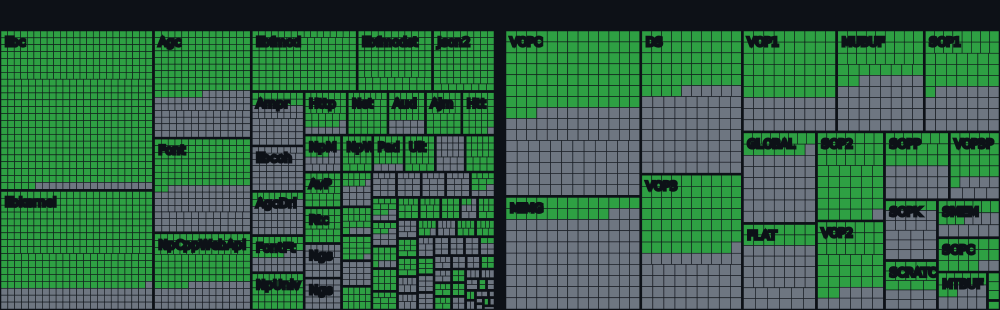
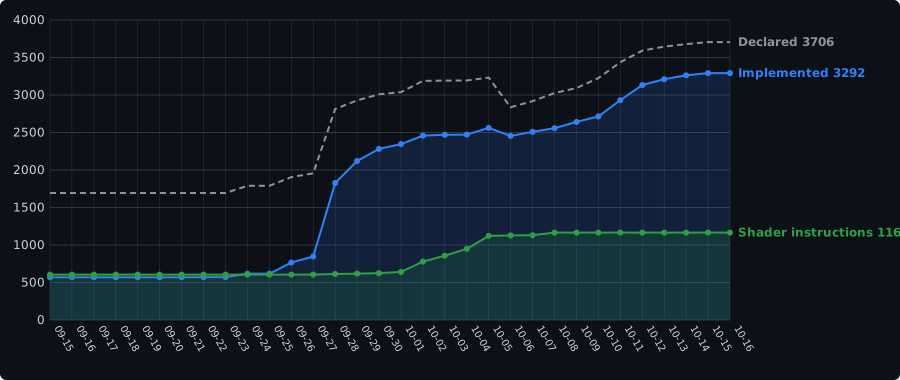
* System libraries: percentage of the functions known to the project so far (declared in core/libs/prx), not of every PS5 system function. The total grows as more functions are declared.
Unsupported or unexpected states strictly throw std::runtime_error. what() is printed to stderr and the process terminates.
The shader recompiler successfully produces SPIR-V (validated via Spirv-Tools when built with ANYPS5_ENABLE_SPIRV_TOOLS).
Compatibility
Per-game progress (stage reached, open blockers, libraries and GPU coverage) is tracked on the blocker map, a community project built from public GitHub data (source). Test reports go in the Game bring-up discussions, one thread per title.
Input mapping
SDL-mapped game controllers are supported, including analog sticks and triggers. Keyboard and mouse controls can be configured with an anyps5-input.ini file. See input mapping for the supported devices and configuration format.
Disclaimer
This project is intended for interoperability, research, preservation, and compatibility purposes. It does not include, distribute, or require copyrighted software, firmware, cryptographic keys, or proprietary libraries. Users are responsible for ensuring that any binaries used with this project are obtained and used in accordance with applicable laws and their respective license terms.
License
This project is licensed under the GNU General Public License version 2 only.