 AlxcBTWandClaude Opus 5.5
24894376ab
A wave64 vertex program runs at one guest lane per invocation, so on a
32-lane host subgroup its lanes 32-63 have no invocation. The vertex
entry still set s3 = 64 | 64 << 8, telling the program that its wave
holds 64 vertices and 64 primitives. An NGG culling program then keys a
full-wave OR on lane < s3's primitive count, lanes 32-63 hold real cull
results, and its v_readlane_b32 of lane 63 cannot be built (#2783).

The entry now sets s3 = 32 | 32 << 8 for a wave64 program on a 32-lane
host, the wave the host runs; the console launches waves with fewer
vertices and primitives. The host subgroup width reaches the vertex
input the way it reaches the compute and mesh inputs
(BuildShaderStageInputInfo from HostSubgroupSize), and the source,
prepared-shader and disk cache keys already carry it for every stage.
Programs that do not read s3 are unchanged; wave32 programs and other
host widths keep the full wave.

The keys are then 0 in lanes 32-63, so the read is sound. On a 32-lane
host, when the existing half-wave scan rules fail, the scan may also:
- run under s_mov_b64 exec, -1 (EXEC constant true);
- use bound_ctrl:1 row_shr steps when 0, the fill, is the identity (OR,
  add, unsigned max), also into another register, whose old value never
  shows since such a step writes every lane;
- take keys shown to be 0 in lanes 32-63: built from 0 through selects
  under a lane id or v_mbcnt of -1 below at most 32, v_cmp_ne_u32 against
  0, ORs, DPP and permlanes, in stages whose entry EXEC is every lane.
Lane 63 is then the identity and lane 31 the subgroup reduction of the
host's invocations. A shuffle from lane 31 is not enough: an RTX 5070
runs the vertex warps of a non-indexed triangle list with 30 of their 32
invocations. A v_readlane_b32 outside the host subgroup of another value
that is 0 in lanes 32-63 reads 0. Only reads that used to throw change,
besides lane 31 of such scans.

Co-Authored-By: Claude Opus 5.5 <noreply@anthropic.com>
About
Tool for automatic executables porting to Linux and Windows.
Includes a relinker that converts executable to the target system's native format and implementations of system prx libraries suitable for dynamic linking. No emulation or separate runtime process.
Usage, Build instructions, Architecture, Technical debt of the project, code style conventions, contributing
Status


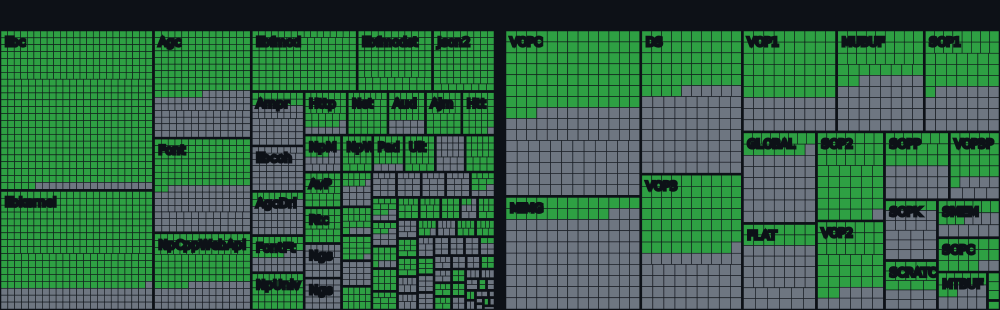
* System libraries: percentage of the functions known to the project so far (declared in core/libs/prx), not of every PS5 system function. The total grows as more functions are declared.
Dreaming Sarah (2D platformer) runs at a stable 60 fps on a GTX 1050 Ti / i5-7500 3.4GHz.
Unsupported or unexpected states strictly throw std::runtime_error. what() is printed to stderr and the process terminates.
The shader recompiler successfully produces SPIR-V (validated via Spirv-Tools when built with ANYPS5_ENABLE_SPIRV_TOOLS).
Compatibility
See the game compatibility list for tested games and known issues.
Input mapping
SDL-mapped game controllers are supported, including analog sticks and triggers. Keyboard and mouse controls can be configured with an anyps5-input.ini file. See input mapping for the supported devices and configuration format.
Disclaimer
This project is intended for interoperability, research, preservation, and compatibility purposes. It does not include, distribute, or require copyrighted software, firmware, cryptographic keys, or proprietary libraries. Users are responsible for ensuring that any binaries used with this project are obtained and used in accordance with applicable laws and their respective license terms.
License
This project is licensed under the GNU General Public License version 2 only.